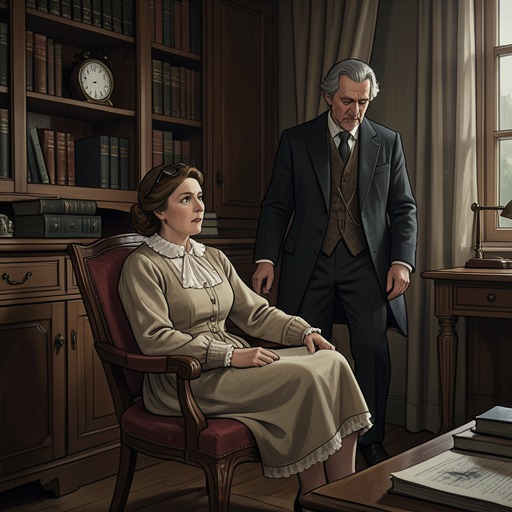
Henry’s letter to Clare to be opened in the event of his death
The Time Traveler's WifeHenry’s letter to Clare to be opened in the event of his death is Henry DeTamble’s attempt to leave Clare Abshire a message that can reach her after he is no longer present. Written on December 10, 2006, while he sits alone at his desk, it addresses the uncertainty of his impending death and the years Clare has spent waiting through his involuntary absences. Its farewell asks her to live beyond that waiting, yet its account of a future encounter gives her a particular reason to believe that their separation will not be final.
The Letter and Its Occasion
The document is headed “Letter to Be Opened in the Event of My Death” and dated December 10, 2006. Henry writes from the back bedroom, looking toward Clare’s studio across the backyard on a winter evening. Clare is away at Alicia’s recital at St. Lucy’s; the house is quiet, and the icy scene outside seems to slow time. That stillness leads him to write because he wants to leave something for the time after him.
Henry says his reserves of energy, pleasure, and duration feel diminished, and that he does not feel capable of continuing much longer. He cannot state with certainty what will happen: even the possibility that Clare is reading the letter after his death is framed as probable rather than absolutely assured. His caution suits a life in which absence and return have never followed ordinary expectations. He hopes his death will be simple and unambiguous, and apologizes for the trouble it might cause. The letter is therefore not a report from beyond death but a message written in the face of uncertainty, with Henry trying to prepare Clare without pretending that he can control what comes next.
Love, Absence, and the Request to Live
Henry tells Clare that their love has been the thread through the labyrinth and the only thing in his strange life he could trust. He imagines that love as more substantial than he is, something capable of remaining after his death and surrounding and protecting her. The image shifts the letter’s measure of endurance: Henry may disappear, but the bond he names is imagined as able to persist in his place.
He knows that Clare has waited for him throughout her life, never knowing whether an absence would last ten minutes, ten days, or a month. Comparing himself to a sailor buffeted by waves, he acknowledges how unreliable a husband his time-displacements have made him. His request is direct: after his death, Clare should stop waiting, put him within herself, and go out into the world to live. He does not deny what she has made of her life. He recognizes the beauty and meaning of her art and the importance of their daughter, Alba, while also admitting that his absences have left Clare’s life suspended around the possibility of his return.
The letter makes that request through Henry’s memory of his own father after his mother died. He recalls that his mother’s absence consumed his father’s life, marking every minute and diminishing the dimension of every action. Only as an adult does Henry understand how absence can remain actively present, like a damaged nerve. This memory gives his appeal to Clare a family history: he wants her grief not to take the shape he witnessed in his father. Yet his wish that she be free stands beside his conviction that he could not survive a life without her, exposing the unequal terms of the farewell. He asks Clare to release him from waiting while confessing that he himself could not bear the equivalent loss.
The Future Encounter and the Promise of Return
Before closing, Henry discloses a vision he has hesitated to tell Clare about. The previous summer, while sitting in David Kendrick’s waiting room, he suddenly found himself in an unfamiliar house. In a dark hallway cluttered with galoshes and smelling of rain, he followed a rim of light to a door and looked into a bright room. There he saw a woman with long white hair, wearing a coral-colored cardigan and sitting by a cup of tea. When she turned, he recognized Clare as an old woman in the future.
Henry describes the encounter as a reunion that felt like arriving from death to hold her and see the years present in her face. He withholds further details so that Clare can meet the future without having rehearsed it in advance. That restraint is part of the letter’s tenderness: the disclosure offers reassurance, but Henry does not turn the vision into a complete account or a guarantee that can remove the uncertainty of waiting. He tells her only that they will see each other again and urges her to live fully in the present world, which he calls beautiful.
Form and Narrative Significance
The letter is a message from one point in time to another, written before the loss it anticipates and read in the novel’s later sequence after Henry’s death. Its dated, intimate address makes the future reader part of the scene: Henry writes to Clare while she is away, but the text reaches her in a circumstance he can only describe as probable. His words consequently hold two moments together, the winter evening of composition and the later act of reading.
The letter also gathers the novel’s recurring tensions into a personal farewell. Henry’s life is governed by involuntary departures, while Clare’s has been shaped by waiting; he cannot promise uninterrupted presence, but he can leave her an account of a future meeting. His instruction to stop waiting is complicated by the very revelation that may sustain her hope. The document neither cancels grief nor resolves the uncertainty of their separations. Instead, it gives Clare a way to understand Henry’s absence and a glimpse of the reunion that the novel later stages when Henry encounters her as an old woman in 2053.